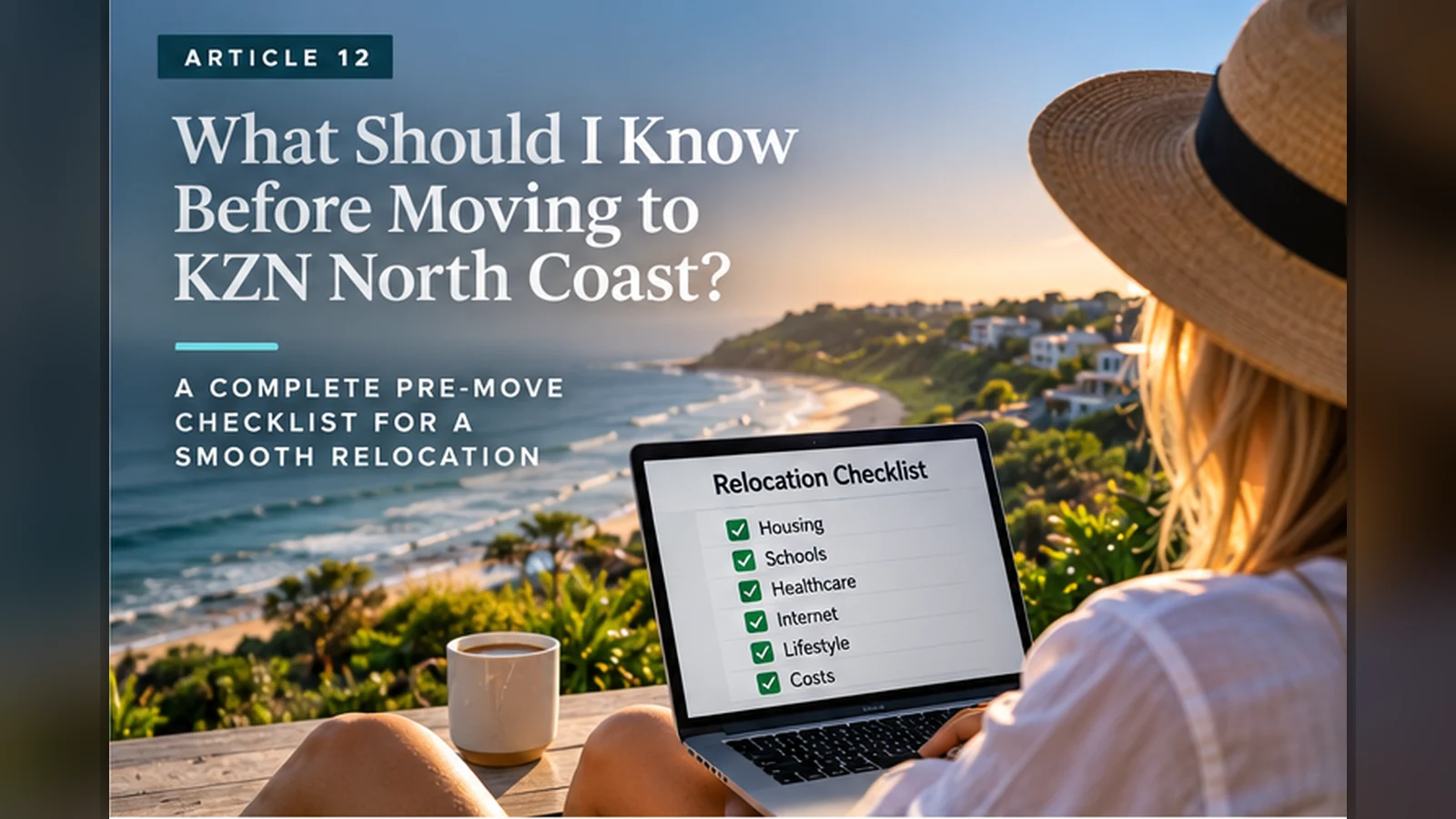
Moving to KwaZulu-Natal’s North Coast can bring a welcome change of environment, but the practical work begins long before the furniture arrives. You need to choose a neighbourhood, understand the full housing cost, investigate schools or work routes, check municipal services and make sure the property supports normal life. A successful move is less about selecting the most attractive coastal photograph and more about removing unpleasant surprises.
This guide is for households relocating from Durban, elsewhere in South Africa or abroad. It covers the questions worth answering before signing a lease or an offer to purchase. Not every household will need every item; use it to create your own checklist and confirm current local details with the relevant authorities and service providers.
Understand which North Coast you are moving to
The term “North Coast” can be used broadly. Umhlanga, Umdloti, Westbrook, Ballito, Salt Rock, Sheffield Beach, Tinley Manor and Blythedale offer different distances from workplaces, shopping and schools. Some fall within the eThekwini metropolitan area, while others are under KwaDukuza and other local-government arrangements. This matters for rates, utility providers, public services and beach monitoring. A search result for a town name does not necessarily tell you the municipality of a particular stand.
Before comparing prices, mark your workplace, preferred school, regular healthcare provider and everyday shopping on a map. Look at the exact entrances to the roads you will use. Explore Selling North Coast suburb profiles and estate profiles, but test each property’s practical location independently. The correct location is the one that supports your household’s routine, not the one with the most prestige.
Decide whether to rent first
If you have not lived in the area, renting for an initial period can reveal whether your expectations match the reality. You can learn how school-holiday traffic changes, where you prefer to shop and whether the climate or a particular building suits you. This may be valuable if you are deciding between Ballito and Umhlanga or if your employment arrangements could still change. A lease has its own legal commitments, so review the term, cancellation provisions and deposit obligations carefully.
Buying immediately can still be reasonable if you know the area, have stable work and have checked the property thoroughly. Just avoid buying under artificial pressure. Add transfer costs, possible levies, municipal rates, maintenance and the cost of the move to the budget. SARS transfer-duty guidance is an authoritative starting point for tax thresholds, but a conveyancer should provide an itemised estimate for your particular transaction.
Make a realistic household budget
Property advertisements show rent or asking price, not the full cost of occupancy. A freehold house may need separate security, garden and pool services. A sectional-title unit or estate home may involve levies and special contributions. Utilities, insurance, mobile data, internet, refuse, sanitation, maintenance and vehicle use belong in the calculation. Request recent bills and tariff information, especially for properties with high electricity demand or extensive garden irrigation.
KwaDukuza adopted tariff changes for 2026/27, as described by the North Coast Courier. Such announcements show why annual budgeting matters, but they do not predict a particular household’s charges. Keep contingency money available after the move for unexpected repairs, deposits, appliance replacements or changes to the first few utility accounts.
Test your work and school routes
Do not rely on a travel estimate taken during a quiet evening. Drive the intended route during an ordinary school-term weekday and test the return trip. Include parking, school pickup and the journey from an estate entrance to the actual home. If you work in Umhlanga, a Ballito address may be practical with flexible hours, but commuting to central Durban can change the equation. More distant coastal villages deserve a particularly careful examination if you need to be in the office every day.
National toll tariffs changed from March 2026, so calculate route-specific toll expenses using current information. Include the annual costs of fuel, servicing, tyres and insurance. School transport and extracurricular activities can multiply the journeys required. A lower rent may offer little benefit if it creates a costly, exhausting daily schedule.
Find a school before choosing a house
For families, the school should often be the starting point. Research local public and independent options, arrange campus visits and ask directly about admissions. Around Ballito and Salt Rock, schools worth investigating include Ashton International College and Curro Salt Rock. Crawford International North Coast is located at Westbrook, and Reddam House Umhlanga serves families in the northern metropolitan area.
These examples do not constitute school rankings. Compare curriculum, child-specific support, fees, aftercare and the availability of space. A family arriving from abroad should examine how qualifications and grade placement translate from its previous education system. Confirm transport and school start times before buying a home. A house near a desirable school does not automatically entitle a child to a place.
Investigate the actual services at the address
Check the electricity account or prepaid meter, water arrangements, refuse collection, sanitation and any backup systems. In a complex, find out whether generators or batteries power individual units, security systems, water pumps or only common lighting. Ask how residents are notified of outages. In a developing estate, establish whether promised roads, facilities and utilities are fully commissioned or still planned. Written, current details are more useful than general assurances.
For internet, confirm fibre availability at the specific unit. A provider showing a suburb as covered does not guarantee a connection in every building. Ask about installation, service-provider choice, building approvals and backup connectivity. If you rely on video meetings, test upload quality and mobile reception indoors. Remote working should be treated as an infrastructure requirement, not just a lifestyle benefit.
Understand coastal weather and building maintenance
The climate supports outdoor living but can create challenges for buildings. Check for damp, drainage problems, exposed metal corrosion and maintenance of sliding doors or air-conditioning. Before buying, obtain an independent building inspection suitable for the property. For sectional title, investigate the body corporate’s maintenance responsibilities and financial reserves. For a freestanding house, plan for your own roof, external paint, garden and security maintenance.
If renting, document the condition at move-in and clarify responsibility for gardens, swimming pools and equipment servicing. Ask whether major building works are planned. A quiet balcony during a viewing may become a construction-facing balcony months later. Pay particular attention to properties on slopes or near exposed coastlines and ask qualified specialists about drainage or structural concerns when relevant.
Check security without relying on labels
An estate gate can form part of a security arrangement, but it is not a guarantee. A well-managed apartment building or freestanding home outside an estate may also suit your requirements. Examine controlled access, lighting, locks, gate motors, emergency access, visitor procedures and any armed-response arrangements. Inspect the street in the evening where safe and practical. Compare the cost of an estate levy with any security and maintenance services you would arrange independently.
For wider context, review SAPS crime statistics, remembering that police-station figures cover broader areas and reported incidents. Ask residents about local procedures, but treat rumours carefully. Insurers may set requirements for alarms or physical protection, so confirm those conditions before occupation.
Plan healthcare and insurance early
Research routine medical providers, emergency facilities, pharmacies and the travel time from your intended address. Check whether your medical scheme covers the preferred network and confirm any ongoing medication availability. If you have young children, older relatives or recurring medical appointments, proximity matters more than the scenic quality of the drive. Keep emergency contacts accessible to family members and any household staff who may need them.
Update building, contents and motor insurance as appropriate. Coastal exposure, security arrangements and occupancy conditions can affect cover. If buying, arrange the correct cover to begin at the contractual risk date, not simply the date you collect keys. For an estate or complex, ask which structure and common property are insured collectively and what you must insure separately.
If relocating from abroad, deal with legal status first
Foreign ownership of South African property and the legal right to live or work in South Africa are separate issues. The government’s permanent residency page outlines some immigration routes, but individual circumstances require current professional advice. Check work authorisation, visas, schooling documentation, tax residency and banking or exchange-control issues before committing to a permanent property purchase.
Use a qualified conveyancer and verify any estate agent through the PPRA’s certificate portal. Independently confirm banking details before transferring a deposit. If importing possessions, vehicles or pets, investigate applicable customs, transport and veterinary requirements with the responsible authorities. Timelines can affect when your household can realistically move into a property.
A useful final week-before-moving checklist
Confirm the lease or transfer arrangements, meter readings, utility-account handover, keys, access tags, fibre appointment and insurance start date. Measure furniture against doorways and lifts. Arrange waste and packaging removal, check parking for the moving vehicle and notify building management. Keep passports, identification, medications, valuables and important contracts with you rather than in an unlabelled moving box.
Once you arrive, prioritise a functioning home rather than attempting to explore every beach immediately. Establish school and work routes, test alarms and connectivity, locate essential shops and identify emergency contacts. The most successful North Coast move usually begins with ordinary practical competence; enjoyment of the coastline follows naturally when the essential routines work.
Frequently asked questions
Should I move to Ballito or Umhlanga?
Choose by workplace, school, housing budget and preferred daily rhythm. Visit both and compare specific neighbourhoods and properties.
Should I buy before relocating?
If you know the region well and have completed due diligence, it may make sense. Renting first can be valuable when you are unfamiliar with the area.
Are coastal homes harder to maintain?
Some face more salt, moisture and weather exposure. Maintenance needs differ by design, age and location, so inspect the individual property.
What paperwork matters most for a buyer?
Identity and source-of-funds documentation, the signed contract, finance conditions, property information and conveyancer instructions are central. Your attorney will confirm specifics.
What should I check on a property viewing?
Access, drainage, damp, security, noise, parking, fibre, utilities, management rules and how the location fits your work and school routes.
Further reading: SARS property transfer duty · PPRA verification · South African Government residency.