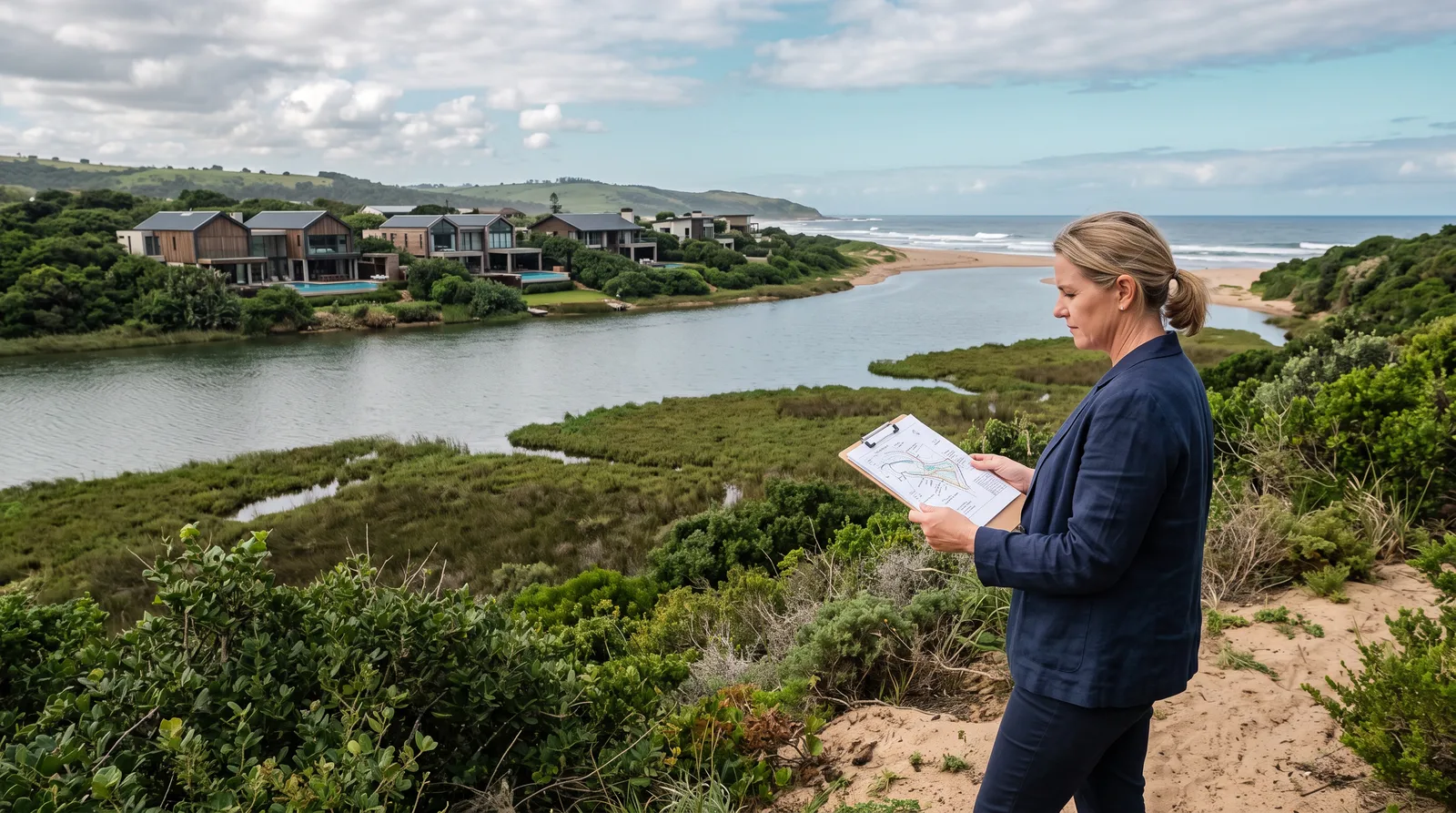
For buyers considering property near lagoons, estuaries and rivers, choosing where and how to live on the KwaZulu-Natal North Coast requires more than an attractive listing photograph and a sunny weekend. A permanent home or property purchase needs a stronger foundation. The area contains established residential streets, smaller coastal settlements, apartments and managed estates, with different costs, services and everyday routines. No single town or property type is automatically the best choice.
This guide focuses on testing a water-view price premium against environmental and legal exposure. We examine what a household can observe, what needs documentary evidence, where external sources help and how to compare the alternatives fairly. The places considered include Zinkwazi, Umdloti and river or estuary-adjacent parts of the North Coast. Specific prices, admissions, availability, regulations and operating conditions can change, so readers should verify them directly before committing. Our aim is to make your shortlist more intelligent, not to pretend that an editorial guide replaces a conveyancer, qualified inspector, insurer or other relevant professional.
Riverfront is not one type of property
A tidal estuary, freshwater river, lagoon edge, wetland outlook and home with a distant water view involve different access, ecological and development conditions. Listings may use waterfront language loosely. Before paying a premium, establish precisely what boundary, title and lawful access rights exist.
A useful way to test this issue is to turn the broad claim into something observable at the address or within your own household. Get a cadastral plan, title review and physical site inspection that identifies the real high-water or flood-sensitive area. Record the result, the date and any unanswered questions. If you cannot establish the answer independently, assign it a lower confidence level rather than filling the gap with an optimistic assumption. A photograph across water does not prove ownership of the bank or exclusive access. That discipline is especially valuable for buyers considering property near lagoons, estuaries and rivers: it ensures that a compelling property description never replaces the ordinary conditions that determine whether an address works after the excitement of moving has faded.
The view premium needs comparable evidence
A premium may be reasonable for a scarce, legally usable view, but the amount cannot be derived from emotion. Compare registered sales for similar home size, elevation, access, flood exposure and building condition. Active asking prices can provide context but are not proof of what buyers will pay.
For a meaningful comparison, hold the important variables steady. Compare homes of similar size and purpose, then note where the view premium needs comparable evidence changes the result. Request like-for-like registered comparables and adjust for risk and future maintenance. This prevents one candidate winning merely because it has a better photograph or more persuasive marketing copy. Never apply the price of a sea-facing estate villa to a very different estuary lot. If a point is uncertain, ask for dated evidence, a written quotation or an independent professional assessment as appropriate. Over time, a small collection of verifiable facts is more useful than a long list of general claims about the whole North Coast.
Check flood lines and historical events
Flood exposure is site-specific. Drainage paths, upstream catchments, past flooding and changing rainfall can affect low-lying property. KZN coastal and estuary guidance aims to reduce harm to people and infrastructure. A qualified engineer or environmental professional should evaluate uncertain conditions.
Put the decision into an ordinary Tuesday rather than an ideal holiday. Imagine work obligations, school collections, shopping, healthcare, an unexpected errand and the time needed to get home. Ask for flood mapping, historical claims and municipal planning information before offer acceptance. Compare how that routine would operate from two different addresses. A dry viewing on a sunny afternoon does not establish low flood risk. When an apparently minor issue recurs several times each week, its cost becomes important even without a direct invoice. A practical location decision should account for time, inconvenience, reliability and the ability to manage when the first choice is unavailable.
Coastal management controls and building rights
The Integrated Coastal Management Act and provincial coastal management lines can restrict development or protection measures. A buyer must confirm setbacks, environmental approvals and permitted alterations. The ability to see the river is not permission to build a jetty, clear reeds or extend a deck.
This is a place for a written record, not simply a verbal reassurance. Ask planning authorities and conveyancers to confirm rights and relevant approvals in writing. Save details that can be checked later, including the date of the enquiry and the person or organisation responsible. Do not rely on a seller’s verbal promise that waterfront works will be approved. If you are uncertain about a legal, financial, health or structural point, use the relevant qualified professional rather than relying on informal advice. This makes it easier to distinguish a manageable compromise from a genuine reason to pause or walk away, and reduces the chance that a household will discover an expensive misunderstanding after moving in.
Maintenance and structural risk
Waterfront homes may face damp, corrosion, insect exposure, drainage pressure, erosion or retaining-wall concerns depending on site conditions. Structural repair costs can erase an apparent purchasing discount. A qualified building survey and specialist engineering assessment can identify expensive hidden work.
The underlying choice usually involves two reasonable priorities, not an obvious right answer. One buyer may value convenience, while another accepts a longer drive in exchange for privacy or extra space. Commission an inspection focused on foundations, walls, bank stability and drainage as appropriate. Write down what you gain and give up in both directions. A landscaped garden cannot substitute for evidence that retaining structures are sound. The best decision is the one that remains tolerable when circumstances are less favourable: traffic increases, a child needs an extra trip, weather changes or a regular payment rises. A trade-off you understand is much less risky than a supposed benefit that has never been tested.
Insurance and lender scrutiny
Insurers and lenders may evaluate flooding, erosion and access risk at the specific parcel. Cover exclusions, excesses or finance conditions can affect both ownership and resale. A property with an appealing asking price but restricted insurance options may be expensive over time.
Costs and responsibilities deserve the same attention as the visible feature. Seek written insurer and lender feedback before becoming unconditionally committed. Ask who is responsible, how frequently the service or facility is used, what is included in any fee and what happens when it fails. Do not assume the previous owner’s policy will transfer on identical terms. Distinguish a recurring cost from a one-off payment, then account for maintenance or replacement over several years. This prevents a seemingly inexpensive choice from becoming expensive through accumulated time, travel or repairs. Your personal budget and risk tolerance should determine the acceptable level of exposure.
Shared access and environmental responsibilities
Riverfront neighbourhoods can have public, communal or restricted access, and conservation protections may apply. Understand ownership boundaries, servitudes, common-property rules and responsibilities for vegetation or bank maintenance. A scenic setting should not become a source of neighbour disputes.
Try a conservative scenario before deciding. Suppose your first-choice plan becomes temporarily unavailable, a bill rises, bad weather interrupts access or a routine journey takes longer. Review title conditions, servitudes, environmental authorisations and any managing-body rules. Think through the alternative and the money or time it requires. Do not assume that a water-facing home owns the water or may alter its surroundings. A robust decision works without assuming every system and every person will perform perfectly. It should also leave room to change course if circumstances develop differently from your expectations. This is particularly useful in the diverse North Coast property market, where one street and the next can operate differently.
Set a risk-adjusted offer ceiling
Start with comparable safe-location property value, then separately value actual water access and outlook. Deduct realistic allowances for repairs, insurance constraints, flood mitigation where lawful and marketability. If evidence is uncertain, retain contractual protections or walk away.
Bring together the evidence from this section with the wider picture of testing a water-view price premium against environmental and legal exposure. Have a conveyancer and appropriate specialist review findings before finalising the offer. Compare what you know from documents with what you observed personally, and flag any conflict for follow-up. No view premium is worth an unquantified legal or structural exposure. A decision becomes more defensible when you know which facts are confirmed, which are estimates and which are personal preferences. Before signing or relocating, make sure the remaining uncertainties are acceptable to everyone affected. That is how a broad lifestyle ambition becomes a practical plan rather than a series of hopeful guesses.
Frequently asked questions
Is riverfront property always a poor investment?
No. Outcomes depend on price, rights, location, risk, maintenance and resale evidence. The sensible next step is to define what the answer would look like for your own household and then test it against the exact property or neighbourhood. There can be meaningful differences even within one street or complex. Use current, primary information and keep written evidence of any cost, access or restriction you intend to rely on. This is especially important where money, safety or a long-term commitment is involved.
Does an attractive lagoon view mean I can build a jetty?
No. Development and coastal permissions must be assessed independently. Location names are only a starting point. The type of dwelling, its condition, access arrangements and your weekly routine can completely change the answer. Compare two or three real options using the same criteria, and ask whether the apparent advantage persists under ordinary working-day conditions. Do not let an attractive sales description become a substitute for an objective check.
What is the first step before making an offer?
Verify title and access rights, flood exposure, planning conditions and registered comparables. If you are making a major financial or life decision, an independent second opinion is often worth the expense. Request written confirmation of what is included and of any important limitations, and keep enough flexibility for unexpected changes. A cautious decision is not necessarily the cheapest one today; it is one that you can sustain after the initial move or purchase.
The final decision
The best way to decide is to convert testing a water-view price premium against environmental and legal exposure into a shortlist of facts you can verify. Put the options side by side, keep their property types comparable, and distinguish financial commitments from lifestyle preferences. Where a claim concerns medical treatment, planning permission, safety, legal rights, finance or recurring service availability, obtain an up-to-date answer from the relevant professional or institution.
Look beyond one unusually good viewing. Visit the places that interest you at different times, check the real costs and routes, and ask what happens if an important assumption proves wrong. This habit does not remove every uncertainty, but it turns a vague impression into a reasoned decision. For buyers considering property near lagoons, estuaries and rivers, the objective is a North Coast life that remains enjoyable, reliable and financially sustainable after the first few months.
Explore our North Coast estate profiles, suburbs and local area guides and current property listings to compare actual homes with the issues raised in this article.
Sources and further reading
- Coast KZN: coastal management lines
- Government: Integrated Coastal Management Act
- ImmoAfrica: KZN North Coast active asking-price guide (31 October 2026)
- Property Practitioners Regulatory Authority: verify an agent
Research note: This article reflects sources and public information reviewed on 1 November 2026. Market statistics are labelled as asking prices or reported estimates where applicable; illustrative cost examples are not live quotations. Always confirm time-sensitive details directly.